
|
|
|
|
|
|||||||
|
|
|
|
|
|
|
|
|
|
|
|
|
In der Rolle Antigones
Die Sprache der Schriftsteller als Stimme der Gesellschaft
Von Suso de Toro - 2004
We tend to forget that all social life, including politics, is language. These are not realities which exist only on this verbal level, but for human beings life is language. And, on the contrary to the Hegelian idea that history is an objective concurrence of rational or rationalized forces, human social life is entirely made up of the language it bears within: in both rational content as well as in that other something which we call "the irrational".
For contemporary Westeners the word "irrational" carries with it suspicious stigmatized overtones, things which must b fought against. But, by not trusting and fighting against this area of life which we call "the irrational", an area made up of symbolic and mythical forms, what we are really doing is to show a type of self-hate, a disdain towards the most valualble part that we possesses: our emotional world, the primordial and the most profound part of us. This deep division into two parts which fight against each other, this struggle between Jekyll and Hyde, is one of the legacies of the Enlightment and of Modernity. This Modernity which breaks down the myth is that which, after the historical experiences of Communism and the Fascism, tries to reduce social life into a concurrence of forces in conflict within certain pre-established laws. It tries to turn life into a dialogue between logical propositions.
But human beings do not define themselves through logical thinking, which is a simple part of our thought process, but rather through their spiritual and mental world: all through language. A language which transmits our rigid reasoning, and also our emotions: multiform, mobile and ever changing.
Language, through the different languages, is more than anything else for each and every one of us accumulated memory: the memory of a community and also personal memory. And memory, Mnemosine, is also the imagination. Language allows us to to travel backwards or forwards. Because a human being's social life has its logical side situated in the present, which tries to find solutions for the conflicts between different interests, and it also has a side which is conditioned by language and imagination, situated in the past and in the future, which takes us backwards und forwards. This other side where the memory accumulated by the community, with its traumas, fears and anxieties is expressed, is where we can work more or less obsessively with the illusions and dreams of this community and of this indiciduals and groups of individuals. This is the specific field of writers.
We can also say that political life has two different sides; it expresses personal, class, national interests..., it expresses reasoned demands. On the other hand, it shows the so-called "theatrical" side. This side is the one of expression and representation of the individual and collective feelings and emotions. Not only must a good politician be a manager but also an interpreter showing social emotions and working with it prudently; a good politician is not just a good organizer but also a good actor and a psychodrama therapist. No doubt, this side of politics is related to literature.
Under these circumstances, what we might call a "necessary literature" ermerges when politics are unsuccessful, when politicians are unable to sort governmental problems out, when definitely, they cannot face collective emotions. It is then when writers and artists emerge to express once again the primordial word of collectivity. When rational politics, regulated and institutionalized speech are unsuccessful, when Hegelian reasoning fails, it is then that there is a prepolitic regression and writers forget their bourgeoise profession and turn to wear the tunic of the tribal bards to remember the reasoning and emotion of the tribe. It is evident that this situation is momentary, unstable but also tragic and decisive.
Bourgeoisie society and illustration have created the "intellectual", which many times is joined to the figure of the literary writer. Every writer is an intellectual, but many writers are only creative in words of fiction and pure artistic language. They cannot have a perspective of their own task, they cannot analyse the reality surrounding them. But, being unconscious, these writers also modify language and social life with their own work. They introduce thought figures in the collective imagination, they update myths, they express fear ... There are more analytic writers. They can express themselves making use of languages, the rational and the irrational. There are also intellectuals who are not just literary writers and work also with speculative language. These ones are able to acutely see the present and imagine possible futures.
We confirm that the figure of the intellectual becomes practically confused with the "man of letters/Arts". It has a charismatic personality: preferable a severe, academic, mature, authoritarian and "of letters" male. And, really, what this comes to mean is "someone who ignores what is related to science and technology". And this ignorance of the world of the experience, where social transformations take place, is a complete risk since it takes us to speculate in a purely ideological world, a stand-alone world made of language and spinnig over it. This world of ideas tends to paranoia and immobility. This being so, the intellectuals specially literary writers, are able to properly make a part of their work, they object to social transformations (technological, economical, cultural ...). However, they do not always know how to deal with the other side; they do not propose new ways out or ways to follow. To sum up, generally speaking, they do not know how to reconcile their reason as to the rational with state reasons and with technological reason. Perhaps, this happens because there is no possible reconciliation.
The interllectual is a citizen who offers himself/herself to the society als a tool of the collective intellectual lab. From a positive point of view, we can say that his/her role is that of being a "stone to be touched" (litmus paper), detecting errors, and analysing defects. From a negative point of view, we can see the intellectual as a clumsy creating problem in labs and technical jobs. I think he/she is both of them.
No doubt the intellectual has a certain power and he/she is conscious of it. This power is not democratic; it is won in a battle against other intellectuals. And this bellicose and narcissist condition frequently characterizes his/her acts, struggling with ideas and opponents. The ideological fight may become hegemonic in society and it leads the intellectual to become a very active part of any social conflict. We can say that intellectuals are the one who prepare the army the way in their internal, ideological and political wars. It is a pity, sometimes also soldiers.
Anyway, society must know this reason as to the rational that the writer must cultivate. This is a radically individual reason, since literature in contrast with social science is the field of whim, arbitraries, diversity, ... individuality. It is precisely over the human being that democracy must be. Every democratic dream is born from a vindication of the individual. Against the reason of the State the writer must try to say the voice of Antígona, the voice of the human being who is alone.
It is just there, in this line that joins the reason of the State with the personal reason, that the figures of the writer, "dichter", old poet, who was a priest first, and the figure of the bourgeoisie intellectual who defends the necessary collective reason, the survival of the community, of the State, find themselvers and also separate themselves. Sometimes this may lead to pain and indignation.
The writer, that people possessed by language, the melancolic people who looks back, express memory. And memory is necessary counterweight for the very fast social life. And also express a part of the individual and collective life that only may be understood through the myth, the dream and, many times, the delirium. And, in this way, making all it public, the writer makes whole again, reintegrates that dark part to the collective conscience.
When the myth is denied, remains hidden but it becomes wild and cannibal. The myth denied it never disapears, it becomes Mr. Hyde.
In social democratic life, intellectuals are necessary poison who help to heal. When writers who create imagination, dream and prophetic myth act also as intellectuals they can heal twice as much; however, they can also become toxic, dangerous, Dionisiacs. They must be used in small doses since they may help us bring heaven or even hell or apocalypses. It is likely that dangerous stuff is somehow necessary, and no doubt necessary stuff is dangerous.
Die Veröffentlichung erfolgt mit freundlicher Genehmigung von Suso de Toro. Alle Rechte sind beim Autor und unterliegen dem Urheberrecht. Die Wiedergabe dieses Textes, ganz oder teilweise, in jeglichem Medium ist ohne ausdrückliche Zustimmung des Autors nicht gestattet.
Networking European Citizenship Education (NECE)23. Sep 2004 – 26. Sep 2004
https://www.bpb.de/presse/51178/nece-networking-european-citizenship-education
|
 |
© Christa Tamara Kaul
 ::
::

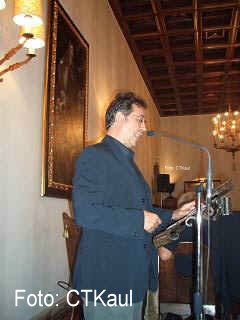
 Autorenportrait: